Monday, October 29, 2007
Frank Wu Article Response
High school was the time I believe in which I was defined by a group of people the most. My high school was very diverse, and if it was not for the football team than I believe I would have been characterized in a different way. I had many black friends on my team. Now we look back and laugh about what and how we thought about each other. My friends believed that because I was white and Catholic, that I was a goodey goodey. They thought I would never want to hang out, listen to the type of music they did, or just overall enjoy life the way they did. Before high school, I had never interacted with an African-American. So I had my stereotypes as well. However, I was truley wrong. My good friend to this day is an African-American and works at Abercrombie. He used to get made fun of all the time because it is out of the ordinary for a black man to work at such a store.

Comic Book Covers
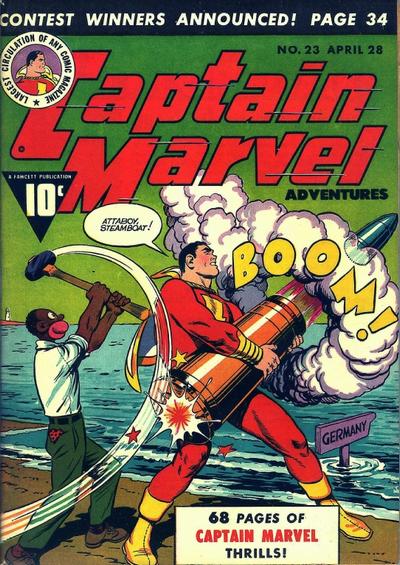
Comic books are made for entertainment purposes. To show us a world with super heroes who protect the good and fight the evil. Yet on one comic book cover I found did not live up to the entertainment. A cover like this, which is made for children, should have never been published.
The “Captain Marvel Adventure’s” comic book cover shows a white man in a super hero outfit holding a cannon. A black man banging the end with a hammer is triggering off the cannon. This picture, itself is disturbing. The white man is drawn to appear as superior with muscles bulging out of his costume tights. The black man is drawn to appear to look more like a monkey than a human being. The cannon is being shot in the direction of Germany, as told by the signs next to the cannon. This is another disturbing factor in the cover as this cover was clearly published during World War II. During a time in which black men and women were still discriminated against and yet the cover shows a black man helping a white man defeat the Germans.
Why did the author of the cover choose to draw this? The author of this cover chose to draw it like this because he wanted to make it seem as if the black man enjoyed helping the white man. He did this by drawing a smile on the black man’s face. The author used propaganda in this cover to help prove a statement that it is ok to help a white man. The author drew the white man superior to the black man. The black man was drawn with a smile on his face to make it seem like he enjoyed helping the white man.
I believe this cover is a counter-act to all the negativity on slavery at the time. The author wanted to prove a point that the black man on the cover was happy to help the white man. I have a problem with this cover because the children who look at this cover grow up to believe that it is ok for a black man to help him/her and there would not be a problem with it. Especially at a time when the nation had to come together during a time like World War II, this cover should have never of been published. The cover should have been drawn with both races as super heroes fighting along side one another. It is unfair to African-Americans who look at this because they too fought in the war and the cover does not justify that at all.
Wednesday, October 24, 2007
Takaki Chapter 10
In Chapter 10 of Takaki, “Pacific Crossings”, Japanese women were forced east to marry Japanese men who had already made their way across the Pacific Ocean. Through out the chapter, Takaki tells the hardships the Japanese women had to endure not only with being in a forceful marriage but living in a new world as well.
In the late 1800s, Japan’s economic system was not where it should have been. The Japanese were unable to pay taxes, especially the agricultural class. Many traveled east to Hawaii and to the rest of the United States. Some Japanese people traveled by their own choice, others were forced. The Japanese people that were forced were the women. They were forced across the Pacific to marry those Japanese men who were already settled. Back then, a Japanese marriage was arranged, and the bride did not have a say in who she wanted to marry. The Japanese women were more excited to experience America and get out of the hardships Japan was going through at the time. These Japanese women who were forced across the ocean to marry were called “picture brides”. Says one picture bride “My young heart, 19 years and 8 months old, burned, not so much with the prospects of reuniting with my new husband, but with the thought of the New World”. The Japanese women were used for not only marriage, but for labor as well. They were needed as workers for their new husbands. A researcher noted in 1915 that “The wives do much work in the fields”. The Japanese women were considered a type of slave, and more as an object that a human being.
Why the Japanese women? The Japanese women were very intelligent than any other race in that day. They were taught literature and a very young age and even knew English. This made the Japanese women easier to cooperate with and tolerate.
This reading was a difficult one to finish as it was one of our longer chapters this semester. It was disturbing reading what the Japanese women had to go through in their life. It is weird to think that back then men were supposed to be the care takers, and yet women were out in the fields contributing to all the hardwork.
In the late 1800s, Japan’s economic system was not where it should have been. The Japanese were unable to pay taxes, especially the agricultural class. Many traveled east to Hawaii and to the rest of the United States. Some Japanese people traveled by their own choice, others were forced. The Japanese people that were forced were the women. They were forced across the Pacific to marry those Japanese men who were already settled. Back then, a Japanese marriage was arranged, and the bride did not have a say in who she wanted to marry. The Japanese women were more excited to experience America and get out of the hardships Japan was going through at the time. These Japanese women who were forced across the ocean to marry were called “picture brides”. Says one picture bride “My young heart, 19 years and 8 months old, burned, not so much with the prospects of reuniting with my new husband, but with the thought of the New World”. The Japanese women were used for not only marriage, but for labor as well. They were needed as workers for their new husbands. A researcher noted in 1915 that “The wives do much work in the fields”. The Japanese women were considered a type of slave, and more as an object that a human being.
Why the Japanese women? The Japanese women were very intelligent than any other race in that day. They were taught literature and a very young age and even knew English. This made the Japanese women easier to cooperate with and tolerate.
This reading was a difficult one to finish as it was one of our longer chapters this semester. It was disturbing reading what the Japanese women had to go through in their life. It is weird to think that back then men were supposed to be the care takers, and yet women were out in the fields contributing to all the hardwork.
Monday, October 22, 2007
Living Jim Crow
In the reading “Wright/The Ethics of Living Jim Crow” I learned to value what I usually don’t, and that is my rights as a civilian. In the reading, there is a young African-American boy who grew up in Arkansas. The young boy experiences a very traumatic time in which he learns the hard way about Jim Crow Laws and how they will effect his everyday life.
The reading begins with the young African-American boy playing with his other black friends in the back of his yard. His yard is behind the railroad tracks and from time to time the black kids and white kids from across the tracks would get into, what the black boy thought was playful fights. The black kids would throw cinder barrage at the white kids, while the white kids would throw cinder barrage back. The playful fight took a turn for the worst as the white kids began throwing broken bottles they found lying around the tracks. The young black boy was hit in the back of an ear with a broken milk bottle and began bleeding profusely. The young boy was in so much pain and when he told his mother what happened she was more disappointed in him than the situation. She looked at the young boy’s wound and slapped him saying “How come yuh didn’t hide? How come yuh awways fightin?” The young boy was saddened and confused by the way his mom reacted. The young boy and his family moved from Arkansas to Mississippi. There the family resides in a black community, far from railroad tracks and white kids. The young boy is so accustomed to living in a black community and being treated like an equal that when it was time to find a job he knew it was going to be with white folks. The young boy received a job and was ridiculed. He was called the n-word like it was his name and when he took a break he was called “lazy”. His co-workers were behind all of the name calling even though they were the ones responsible for helping him learn his way around the job. One day the young boy was in the factory and was confronted by the co-workers. The co-workers made up a story about the boy calling a white man his last name without saying “mr.”. This was a great insult and the black boy would either have to agree to the story or be calling the white man a liar. He was screwed either way and pleaded to let him leave with out getting hurt and he’ll never return. The black boy got away and left the factory without a job.
Is there still racial tension in the workplace? I believe there is not, from my experiences so far in life. I worked in factory myself over the summer, and there I had the opportunity working with a black man and we really hit it off. We worked well together and learned about each other’s past. I have not heard of any racial tension in the work place through the media that I can think of. I believe as a society, we have come so far to not stoop as low as to the co-workers of the black boy in the reading.
I enjoyed this reading a lot. The more we continue this semester the more I am shocked by the stories that occurred in our own country. I think about how Jim Crow Laws were around only fifty years ago and it really makes me appreciate where we are as a country and how we treat others as equal.
The reading begins with the young African-American boy playing with his other black friends in the back of his yard. His yard is behind the railroad tracks and from time to time the black kids and white kids from across the tracks would get into, what the black boy thought was playful fights. The black kids would throw cinder barrage at the white kids, while the white kids would throw cinder barrage back. The playful fight took a turn for the worst as the white kids began throwing broken bottles they found lying around the tracks. The young black boy was hit in the back of an ear with a broken milk bottle and began bleeding profusely. The young boy was in so much pain and when he told his mother what happened she was more disappointed in him than the situation. She looked at the young boy’s wound and slapped him saying “How come yuh didn’t hide? How come yuh awways fightin?” The young boy was saddened and confused by the way his mom reacted. The young boy and his family moved from Arkansas to Mississippi. There the family resides in a black community, far from railroad tracks and white kids. The young boy is so accustomed to living in a black community and being treated like an equal that when it was time to find a job he knew it was going to be with white folks. The young boy received a job and was ridiculed. He was called the n-word like it was his name and when he took a break he was called “lazy”. His co-workers were behind all of the name calling even though they were the ones responsible for helping him learn his way around the job. One day the young boy was in the factory and was confronted by the co-workers. The co-workers made up a story about the boy calling a white man his last name without saying “mr.”. This was a great insult and the black boy would either have to agree to the story or be calling the white man a liar. He was screwed either way and pleaded to let him leave with out getting hurt and he’ll never return. The black boy got away and left the factory without a job.
Is there still racial tension in the workplace? I believe there is not, from my experiences so far in life. I worked in factory myself over the summer, and there I had the opportunity working with a black man and we really hit it off. We worked well together and learned about each other’s past. I have not heard of any racial tension in the work place through the media that I can think of. I believe as a society, we have come so far to not stoop as low as to the co-workers of the black boy in the reading.
I enjoyed this reading a lot. The more we continue this semester the more I am shocked by the stories that occurred in our own country. I think about how Jim Crow Laws were around only fifty years ago and it really makes me appreciate where we are as a country and how we treat others as equal.
Monday, October 15, 2007
Zinn Chapter 9
Throughout our lives we have always been taught by teachers, parents, and friends to stand up for what you believe in and for what you believe is right. We live in a country where we have a right of freedom of speech, and to express ourselves anyway we wish. So when I read Zinn Chapter 9, I was very shocked at the way the rebellious slaves were treated.
Zinn Chapter 9 starts off with explaining how successful the plantation fields were in the 1800s. In 1808, a law was passed to illegalize the imporation of slaves in the United States. However, this law did not prevent plantation owners to keep goin on with their business. “From the beginning, the law went unenforced,” says John Hope Frankline. They realized how hard of workers the African-Americans were and continued on importing slaves into their plantations. This success was because of the hard work the African-American slaves put in day in and day out. Between tobacco, cotton, and rice, African-American slaves were benefiting the white economy in the early years of the United States. However, the African-Americans hard work would not benefit the African-Americans. Slave revolts were not common in the United States because of the fear of the unexpected. However the when the largest slave revolt did occur in the United States, there were great consequences. In the year 1811, near present day New Orleans, four to five hundred slaves came together after a rising at a plantation. With cane knives, axes, and clubs in hand the slaves began marching from plantation to plantation. Along the march, their number began to increase more and more. The slave revolt was eventually attacked by the United States Army. Out of the slave revolt, sixty-six were killed on the spot and another sixteen were tried and killed.
How could the plantation owners continue with the importing of the slaves even after a law was passed to prohibit such a thing? The plantation owners were well aware of the law but they were too greedy to follow it. John Hope Franklin was quoted saying “The long, unprotected coast, the certain markets, and the prospects of huge profits were too much for the American merchants and they yielded to the temptation…”.
Although this reading was one of the more difficult ones to finish, I enjoyed what Zinn had to say. I believe the way he writes and paints a picture in your head as you read, benefits him as a writer. However, I was surprised to see the plantation owner’s actions and how they suffered no consequences yet the African-Americans slaves are the ones who are punished and killed.
Zinn Chapter 9 starts off with explaining how successful the plantation fields were in the 1800s. In 1808, a law was passed to illegalize the imporation of slaves in the United States. However, this law did not prevent plantation owners to keep goin on with their business. “From the beginning, the law went unenforced,” says John Hope Frankline. They realized how hard of workers the African-Americans were and continued on importing slaves into their plantations. This success was because of the hard work the African-American slaves put in day in and day out. Between tobacco, cotton, and rice, African-American slaves were benefiting the white economy in the early years of the United States. However, the African-Americans hard work would not benefit the African-Americans. Slave revolts were not common in the United States because of the fear of the unexpected. However the when the largest slave revolt did occur in the United States, there were great consequences. In the year 1811, near present day New Orleans, four to five hundred slaves came together after a rising at a plantation. With cane knives, axes, and clubs in hand the slaves began marching from plantation to plantation. Along the march, their number began to increase more and more. The slave revolt was eventually attacked by the United States Army. Out of the slave revolt, sixty-six were killed on the spot and another sixteen were tried and killed.
How could the plantation owners continue with the importing of the slaves even after a law was passed to prohibit such a thing? The plantation owners were well aware of the law but they were too greedy to follow it. John Hope Franklin was quoted saying “The long, unprotected coast, the certain markets, and the prospects of huge profits were too much for the American merchants and they yielded to the temptation…”.
Although this reading was one of the more difficult ones to finish, I enjoyed what Zinn had to say. I believe the way he writes and paints a picture in your head as you read, benefits him as a writer. However, I was surprised to see the plantation owner’s actions and how they suffered no consequences yet the African-Americans slaves are the ones who are punished and killed.
Monday, October 1, 2007
Kindred Post 1
We hear the “n-word” thrown out a lot in today’s society. When we hear this word it is almost always in a movie or a comedy show. When the “n-word” comes up it is used in a non-serious, joking manner. As I was reading Kindred, it was shocking to read how two hundred years ago the “n-word” was used in a totally different way.
Kindred starts off in Dana’s house helping her husband unpack some books. Dana begins to feel light headed and the room starting to move. She realizes furniture disappearing and all of sudden she collapses into a woods near a river where there is a young boy drowning. Dana, not thinking where she is or how she got there, rushes to the young boy’s aid. Upon pulling the young boy out of the water there is a white woman, the young boy’s mother, running and screaming for her son’s life. She is blaming Dana for killing her baby and takes out her anger on Dana by hitting her in the shoulder. Dana refuses to give up on the young boy’s life and pushes the white woman away and begins performing mouth to mouth on the young boy. The boy begins to breathe on his own and upon turning around there is a man with a long rifle pointed at Dana. Dana then vanishes back to where she began the chapter with her husband. Upon arriving back home she frightened with her husband by her side. Not knowing what had just happened she opts to stay home and not go outside. At the dinner table she begins to feel the same way she did the last time she vanished. The room starts disappearing and she collapses in a room with the same young boy, who is now a couple years older. The young boy was trying to start his house on fire to take away all of his father’s money. Dana rescues the young boy and the house by preventing the fire from starting. Dana begins to talk to the young boy with whom he refers to her as the “n-word”. He recalls the time where he was drowning and Dana came to his aid. His mom was hesitant to allow Dana near him to help save him because Dana was a “n-word”.
What is the “n-word” in today’s society? I believe that word is used in a joking manner only for those who are allowed to say it. The African-Americans in today’s society use the word the most and actually refer to each other as it. You will never see a member of the opposite race say the “n-word” without some sort of punishment or action being followed.
I believe the “n-word” is a very sensible subject for African-Americans. If they want to use that word and refer to each other as that then that is fine, it is up to them. It is a word that was used to downgrade them in the early years of America. Never should a member of the opposite race feel the need to say it in reference to an African-American. It is wrong and there is no place for it in today’s society.
Kindred starts off in Dana’s house helping her husband unpack some books. Dana begins to feel light headed and the room starting to move. She realizes furniture disappearing and all of sudden she collapses into a woods near a river where there is a young boy drowning. Dana, not thinking where she is or how she got there, rushes to the young boy’s aid. Upon pulling the young boy out of the water there is a white woman, the young boy’s mother, running and screaming for her son’s life. She is blaming Dana for killing her baby and takes out her anger on Dana by hitting her in the shoulder. Dana refuses to give up on the young boy’s life and pushes the white woman away and begins performing mouth to mouth on the young boy. The boy begins to breathe on his own and upon turning around there is a man with a long rifle pointed at Dana. Dana then vanishes back to where she began the chapter with her husband. Upon arriving back home she frightened with her husband by her side. Not knowing what had just happened she opts to stay home and not go outside. At the dinner table she begins to feel the same way she did the last time she vanished. The room starts disappearing and she collapses in a room with the same young boy, who is now a couple years older. The young boy was trying to start his house on fire to take away all of his father’s money. Dana rescues the young boy and the house by preventing the fire from starting. Dana begins to talk to the young boy with whom he refers to her as the “n-word”. He recalls the time where he was drowning and Dana came to his aid. His mom was hesitant to allow Dana near him to help save him because Dana was a “n-word”.
What is the “n-word” in today’s society? I believe that word is used in a joking manner only for those who are allowed to say it. The African-Americans in today’s society use the word the most and actually refer to each other as it. You will never see a member of the opposite race say the “n-word” without some sort of punishment or action being followed.
I believe the “n-word” is a very sensible subject for African-Americans. If they want to use that word and refer to each other as that then that is fine, it is up to them. It is a word that was used to downgrade them in the early years of America. Never should a member of the opposite race feel the need to say it in reference to an African-American. It is wrong and there is no place for it in today’s society.
Subscribe to:
Posts (Atom)