Upon browsing through the League of the South website, I came across many disturbing readings. This website is a recruiting tool to try to pursue others into joining what they believe in. The League of the South believes that what they believe in is the right thing and they are the future of the South.
Across the main page of the website reads “LEAGUE OF THE SOUTH: FOR THE FUTRUE OF THE SOUTH”. The League of the South was formed in Tuscaloosa, Alabama, in June 1994. The group was formed to organize the Southern people so that they might effectively pursue independence and self-government. The ultimate goal of the League of the South is to advance the cultural, social, economic, and political well-being and independence of the Southern people by all honorable means. However, the League of the South members are not revolutionaries. They do not seek to overthrow the United States Government, rather by peaceful legal and constitutional means, to separate themselves from it. The League of the South believes in offering good cooperation towards blacks in the South. They believe all people in the South can work together to make life better for all. The website also states the government in the South would protect all law-abiding citizens.
Why does the League of the South feel a need to liberate from the Unites States Government? The League of the South believe that the United States Government has taken away the free man’s rights and our determined to get them back. The League of the South believes in a safe nation for their families, liberty, and the Gospel of Jesus Christ. They obviously do not believe that the United States of America provides them with that.
I am so confused as to why these types of websites are created. We live in a country that is the greatest in the world, which grants us with so much. However, we have websites like this one that take away pride in the United States. It is hard to believe that people still want to leave this nation even though we know what is out there. Websites like this one just make me mad and confused.
Wednesday, November 21, 2007

Wednesday, November 14, 2007
Abercrombie Post
In today’s society, Abercrombie & Fitch is seen everywhere. From adults to children, people in this country have adapted to the clothing style Abercrombie provides. Dwight McBride’s “Why I hate Abercrombie & Fitch” tells the story of how Abercrombie started. Today you look around and everyone is wearing this popular clothing, yet no one knows how racially charged this money making industry truly is.
The clothing label company “Abercrombie & Fitch” began in 1892. David T. Abercrombie lived in downtown Manhattan and was a committed outdoorsman. David T. Abercrombie founded “Abercrombie & Co.” because of his love for the outdoors and wanting to provide quality gear for hunters. Ezra Fitch, one of Abercrombie’s first employees, approached Abercrombie about a possible business partnership. In 1904 “Abercrombie & Co” officially became “Abercrombie & Fitch”. This partnership was not a healthy one. Abercrombie wanted to continue on with the outdoor gear, while Fitch wanted to expand to the general public. The company was aimed at the young white male. Upon Abercrombie’s retirement in the 1928, “Abercrombie & Fitch” continued to grow in popularity. Throughout the company’s history, “Abercrombie & Fitch” has worked very hard to produce a brand strongly associated with the young, white, upper-class males. “Abercrombie & Fitch” wanted to produce not just clothes but a lifestyle. For example, upon hiring employees, “Abercrombie & Fitch” asks that those who interview fit the “Abercrombie look”. They also have to read a book called the “Abercrombie Look Book”. It is in this book where employees are told how to dress, look, and act in order to work at the store. Within the book there are countless pages of white male and female models, only one model is of color. In the “look book”, Abercrombie continues to discriminate in order to target the young, white, upper-class males. In 2003, a class action lawsuit was filed against “Abercrombie & Fitch” alleging discrimination while hiring employees. The complaint specifically claims that “Abercrombie & Fitch” discriminate in its hiring practices against Latinos, Asian Americans, and African Americans. Clearly “Abercrombie & Fitch” is a racially charged money making industry.
Why would “Abercrombie & Fitch” discriminate in the job hiring practice? “Abercrombie & Fitch” believes in the image they are selling. This is very wrong because with the company trying to sell a lifestyle rather than just clothing, it is causing more discrimination in our country.
I enjoyed reading this article because I used to be an employee at Abercrombie. I did not see racial actions but I did notice how strict the company’s rules are on what someone can and cannot look like. It was an experience working there and I ended up leaving the store because of the strict rules and how mean people are treated at the store.
The clothing label company “Abercrombie & Fitch” began in 1892. David T. Abercrombie lived in downtown Manhattan and was a committed outdoorsman. David T. Abercrombie founded “Abercrombie & Co.” because of his love for the outdoors and wanting to provide quality gear for hunters. Ezra Fitch, one of Abercrombie’s first employees, approached Abercrombie about a possible business partnership. In 1904 “Abercrombie & Co” officially became “Abercrombie & Fitch”. This partnership was not a healthy one. Abercrombie wanted to continue on with the outdoor gear, while Fitch wanted to expand to the general public. The company was aimed at the young white male. Upon Abercrombie’s retirement in the 1928, “Abercrombie & Fitch” continued to grow in popularity. Throughout the company’s history, “Abercrombie & Fitch” has worked very hard to produce a brand strongly associated with the young, white, upper-class males. “Abercrombie & Fitch” wanted to produce not just clothes but a lifestyle. For example, upon hiring employees, “Abercrombie & Fitch” asks that those who interview fit the “Abercrombie look”. They also have to read a book called the “Abercrombie Look Book”. It is in this book where employees are told how to dress, look, and act in order to work at the store. Within the book there are countless pages of white male and female models, only one model is of color. In the “look book”, Abercrombie continues to discriminate in order to target the young, white, upper-class males. In 2003, a class action lawsuit was filed against “Abercrombie & Fitch” alleging discrimination while hiring employees. The complaint specifically claims that “Abercrombie & Fitch” discriminate in its hiring practices against Latinos, Asian Americans, and African Americans. Clearly “Abercrombie & Fitch” is a racially charged money making industry.
Why would “Abercrombie & Fitch” discriminate in the job hiring practice? “Abercrombie & Fitch” believes in the image they are selling. This is very wrong because with the company trying to sell a lifestyle rather than just clothing, it is causing more discrimination in our country.
I enjoyed reading this article because I used to be an employee at Abercrombie. I did not see racial actions but I did notice how strict the company’s rules are on what someone can and cannot look like. It was an experience working there and I ended up leaving the store because of the strict rules and how mean people are treated at the store.
Monday, November 5, 2007
Takaki Chapter 12
1.) The Mexican population began migrating to the southwest of the United States in the beginning of the 1900s. The Mexicans were not forced, but rather migrated by choice. There was a Mexican Civil War going on during this time, and many Mexicans did not feel safe. They crossed the border for fear of their lives and were motivated to keep safe and out of harms way. The Mexicans would only return if peace was made.
2.) The significance to the title “El Norte: The Borderland of Chicano America” was that was the name the Mexicans referred to the United States. The called the United States “El Norte” because the United States is north of the Mexico border. The Borderland of Chicano America was significant because it was the border of the United States, however that part of the United States was made up of a majority of Mexicans.
3.) Mechanisms of social construction would be how the Mexicans attempted to make it on their own in the United States. Crossing the border for fear of their lives, they tried to adapt to the United States and receive a job.
4.) The Mexicans resisted discrimination by actively participating in labor struggles, especially during the Great Depression. They also supported strikes led by trade unions such as the Confedeacion de Uniones de Obretas Mexicanas.
5.) One example of race in Takaki was how the Mexicans were discriminated against in the labor field. They were discriminated because their race was a different color skin compared to everyone else. One example of ethnicity in Takaki was when Mexican-Americans were criticized for not recognizing their ethnicity and heritage on the sixteenth of September.
2.) The significance to the title “El Norte: The Borderland of Chicano America” was that was the name the Mexicans referred to the United States. The called the United States “El Norte” because the United States is north of the Mexico border. The Borderland of Chicano America was significant because it was the border of the United States, however that part of the United States was made up of a majority of Mexicans.
3.) Mechanisms of social construction would be how the Mexicans attempted to make it on their own in the United States. Crossing the border for fear of their lives, they tried to adapt to the United States and receive a job.
4.) The Mexicans resisted discrimination by actively participating in labor struggles, especially during the Great Depression. They also supported strikes led by trade unions such as the Confedeacion de Uniones de Obretas Mexicanas.
5.) One example of race in Takaki was how the Mexicans were discriminated against in the labor field. They were discriminated because their race was a different color skin compared to everyone else. One example of ethnicity in Takaki was when Mexican-Americans were criticized for not recognizing their ethnicity and heritage on the sixteenth of September.
Monday, October 29, 2007
Frank Wu Article Response
High school was the time I believe in which I was defined by a group of people the most. My high school was very diverse, and if it was not for the football team than I believe I would have been characterized in a different way. I had many black friends on my team. Now we look back and laugh about what and how we thought about each other. My friends believed that because I was white and Catholic, that I was a goodey goodey. They thought I would never want to hang out, listen to the type of music they did, or just overall enjoy life the way they did. Before high school, I had never interacted with an African-American. So I had my stereotypes as well. However, I was truley wrong. My good friend to this day is an African-American and works at Abercrombie. He used to get made fun of all the time because it is out of the ordinary for a black man to work at such a store.
Comic Book Covers
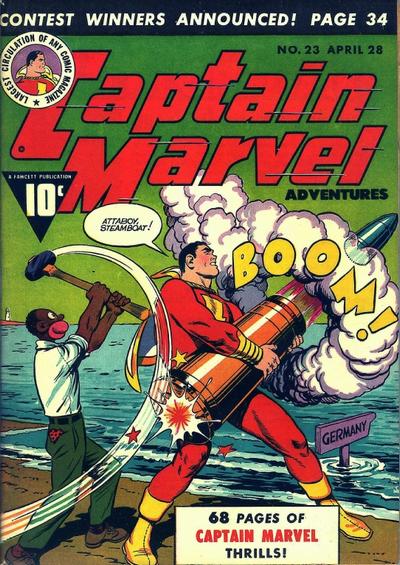
Comic books are made for entertainment purposes. To show us a world with super heroes who protect the good and fight the evil. Yet on one comic book cover I found did not live up to the entertainment. A cover like this, which is made for children, should have never been published.
The “Captain Marvel Adventure’s” comic book cover shows a white man in a super hero outfit holding a cannon. A black man banging the end with a hammer is triggering off the cannon. This picture, itself is disturbing. The white man is drawn to appear as superior with muscles bulging out of his costume tights. The black man is drawn to appear to look more like a monkey than a human being. The cannon is being shot in the direction of Germany, as told by the signs next to the cannon. This is another disturbing factor in the cover as this cover was clearly published during World War II. During a time in which black men and women were still discriminated against and yet the cover shows a black man helping a white man defeat the Germans.
Why did the author of the cover choose to draw this? The author of this cover chose to draw it like this because he wanted to make it seem as if the black man enjoyed helping the white man. He did this by drawing a smile on the black man’s face. The author used propaganda in this cover to help prove a statement that it is ok to help a white man. The author drew the white man superior to the black man. The black man was drawn with a smile on his face to make it seem like he enjoyed helping the white man.
I believe this cover is a counter-act to all the negativity on slavery at the time. The author wanted to prove a point that the black man on the cover was happy to help the white man. I have a problem with this cover because the children who look at this cover grow up to believe that it is ok for a black man to help him/her and there would not be a problem with it. Especially at a time when the nation had to come together during a time like World War II, this cover should have never of been published. The cover should have been drawn with both races as super heroes fighting along side one another. It is unfair to African-Americans who look at this because they too fought in the war and the cover does not justify that at all.
Wednesday, October 24, 2007
Takaki Chapter 10
In Chapter 10 of Takaki, “Pacific Crossings”, Japanese women were forced east to marry Japanese men who had already made their way across the Pacific Ocean. Through out the chapter, Takaki tells the hardships the Japanese women had to endure not only with being in a forceful marriage but living in a new world as well.
In the late 1800s, Japan’s economic system was not where it should have been. The Japanese were unable to pay taxes, especially the agricultural class. Many traveled east to Hawaii and to the rest of the United States. Some Japanese people traveled by their own choice, others were forced. The Japanese people that were forced were the women. They were forced across the Pacific to marry those Japanese men who were already settled. Back then, a Japanese marriage was arranged, and the bride did not have a say in who she wanted to marry. The Japanese women were more excited to experience America and get out of the hardships Japan was going through at the time. These Japanese women who were forced across the ocean to marry were called “picture brides”. Says one picture bride “My young heart, 19 years and 8 months old, burned, not so much with the prospects of reuniting with my new husband, but with the thought of the New World”. The Japanese women were used for not only marriage, but for labor as well. They were needed as workers for their new husbands. A researcher noted in 1915 that “The wives do much work in the fields”. The Japanese women were considered a type of slave, and more as an object that a human being.
Why the Japanese women? The Japanese women were very intelligent than any other race in that day. They were taught literature and a very young age and even knew English. This made the Japanese women easier to cooperate with and tolerate.
This reading was a difficult one to finish as it was one of our longer chapters this semester. It was disturbing reading what the Japanese women had to go through in their life. It is weird to think that back then men were supposed to be the care takers, and yet women were out in the fields contributing to all the hardwork.
In the late 1800s, Japan’s economic system was not where it should have been. The Japanese were unable to pay taxes, especially the agricultural class. Many traveled east to Hawaii and to the rest of the United States. Some Japanese people traveled by their own choice, others were forced. The Japanese people that were forced were the women. They were forced across the Pacific to marry those Japanese men who were already settled. Back then, a Japanese marriage was arranged, and the bride did not have a say in who she wanted to marry. The Japanese women were more excited to experience America and get out of the hardships Japan was going through at the time. These Japanese women who were forced across the ocean to marry were called “picture brides”. Says one picture bride “My young heart, 19 years and 8 months old, burned, not so much with the prospects of reuniting with my new husband, but with the thought of the New World”. The Japanese women were used for not only marriage, but for labor as well. They were needed as workers for their new husbands. A researcher noted in 1915 that “The wives do much work in the fields”. The Japanese women were considered a type of slave, and more as an object that a human being.
Why the Japanese women? The Japanese women were very intelligent than any other race in that day. They were taught literature and a very young age and even knew English. This made the Japanese women easier to cooperate with and tolerate.
This reading was a difficult one to finish as it was one of our longer chapters this semester. It was disturbing reading what the Japanese women had to go through in their life. It is weird to think that back then men were supposed to be the care takers, and yet women were out in the fields contributing to all the hardwork.
Monday, October 22, 2007
Living Jim Crow
In the reading “Wright/The Ethics of Living Jim Crow” I learned to value what I usually don’t, and that is my rights as a civilian. In the reading, there is a young African-American boy who grew up in Arkansas. The young boy experiences a very traumatic time in which he learns the hard way about Jim Crow Laws and how they will effect his everyday life.
The reading begins with the young African-American boy playing with his other black friends in the back of his yard. His yard is behind the railroad tracks and from time to time the black kids and white kids from across the tracks would get into, what the black boy thought was playful fights. The black kids would throw cinder barrage at the white kids, while the white kids would throw cinder barrage back. The playful fight took a turn for the worst as the white kids began throwing broken bottles they found lying around the tracks. The young black boy was hit in the back of an ear with a broken milk bottle and began bleeding profusely. The young boy was in so much pain and when he told his mother what happened she was more disappointed in him than the situation. She looked at the young boy’s wound and slapped him saying “How come yuh didn’t hide? How come yuh awways fightin?” The young boy was saddened and confused by the way his mom reacted. The young boy and his family moved from Arkansas to Mississippi. There the family resides in a black community, far from railroad tracks and white kids. The young boy is so accustomed to living in a black community and being treated like an equal that when it was time to find a job he knew it was going to be with white folks. The young boy received a job and was ridiculed. He was called the n-word like it was his name and when he took a break he was called “lazy”. His co-workers were behind all of the name calling even though they were the ones responsible for helping him learn his way around the job. One day the young boy was in the factory and was confronted by the co-workers. The co-workers made up a story about the boy calling a white man his last name without saying “mr.”. This was a great insult and the black boy would either have to agree to the story or be calling the white man a liar. He was screwed either way and pleaded to let him leave with out getting hurt and he’ll never return. The black boy got away and left the factory without a job.
Is there still racial tension in the workplace? I believe there is not, from my experiences so far in life. I worked in factory myself over the summer, and there I had the opportunity working with a black man and we really hit it off. We worked well together and learned about each other’s past. I have not heard of any racial tension in the work place through the media that I can think of. I believe as a society, we have come so far to not stoop as low as to the co-workers of the black boy in the reading.
I enjoyed this reading a lot. The more we continue this semester the more I am shocked by the stories that occurred in our own country. I think about how Jim Crow Laws were around only fifty years ago and it really makes me appreciate where we are as a country and how we treat others as equal.
The reading begins with the young African-American boy playing with his other black friends in the back of his yard. His yard is behind the railroad tracks and from time to time the black kids and white kids from across the tracks would get into, what the black boy thought was playful fights. The black kids would throw cinder barrage at the white kids, while the white kids would throw cinder barrage back. The playful fight took a turn for the worst as the white kids began throwing broken bottles they found lying around the tracks. The young black boy was hit in the back of an ear with a broken milk bottle and began bleeding profusely. The young boy was in so much pain and when he told his mother what happened she was more disappointed in him than the situation. She looked at the young boy’s wound and slapped him saying “How come yuh didn’t hide? How come yuh awways fightin?” The young boy was saddened and confused by the way his mom reacted. The young boy and his family moved from Arkansas to Mississippi. There the family resides in a black community, far from railroad tracks and white kids. The young boy is so accustomed to living in a black community and being treated like an equal that when it was time to find a job he knew it was going to be with white folks. The young boy received a job and was ridiculed. He was called the n-word like it was his name and when he took a break he was called “lazy”. His co-workers were behind all of the name calling even though they were the ones responsible for helping him learn his way around the job. One day the young boy was in the factory and was confronted by the co-workers. The co-workers made up a story about the boy calling a white man his last name without saying “mr.”. This was a great insult and the black boy would either have to agree to the story or be calling the white man a liar. He was screwed either way and pleaded to let him leave with out getting hurt and he’ll never return. The black boy got away and left the factory without a job.
Is there still racial tension in the workplace? I believe there is not, from my experiences so far in life. I worked in factory myself over the summer, and there I had the opportunity working with a black man and we really hit it off. We worked well together and learned about each other’s past. I have not heard of any racial tension in the work place through the media that I can think of. I believe as a society, we have come so far to not stoop as low as to the co-workers of the black boy in the reading.
I enjoyed this reading a lot. The more we continue this semester the more I am shocked by the stories that occurred in our own country. I think about how Jim Crow Laws were around only fifty years ago and it really makes me appreciate where we are as a country and how we treat others as equal.
Subscribe to:
Posts (Atom)