Upon browsing through the League of the South website, I came across many disturbing readings. This website is a recruiting tool to try to pursue others into joining what they believe in. The League of the South believes that what they believe in is the right thing and they are the future of the South.
Across the main page of the website reads “LEAGUE OF THE SOUTH: FOR THE FUTRUE OF THE SOUTH”. The League of the South was formed in Tuscaloosa, Alabama, in June 1994. The group was formed to organize the Southern people so that they might effectively pursue independence and self-government. The ultimate goal of the League of the South is to advance the cultural, social, economic, and political well-being and independence of the Southern people by all honorable means. However, the League of the South members are not revolutionaries. They do not seek to overthrow the United States Government, rather by peaceful legal and constitutional means, to separate themselves from it. The League of the South believes in offering good cooperation towards blacks in the South. They believe all people in the South can work together to make life better for all. The website also states the government in the South would protect all law-abiding citizens.
Why does the League of the South feel a need to liberate from the Unites States Government? The League of the South believe that the United States Government has taken away the free man’s rights and our determined to get them back. The League of the South believes in a safe nation for their families, liberty, and the Gospel of Jesus Christ. They obviously do not believe that the United States of America provides them with that.
I am so confused as to why these types of websites are created. We live in a country that is the greatest in the world, which grants us with so much. However, we have websites like this one that take away pride in the United States. It is hard to believe that people still want to leave this nation even though we know what is out there. Websites like this one just make me mad and confused.
Wednesday, November 21, 2007

Wednesday, November 14, 2007
Abercrombie Post
In today’s society, Abercrombie & Fitch is seen everywhere. From adults to children, people in this country have adapted to the clothing style Abercrombie provides. Dwight McBride’s “Why I hate Abercrombie & Fitch” tells the story of how Abercrombie started. Today you look around and everyone is wearing this popular clothing, yet no one knows how racially charged this money making industry truly is.
The clothing label company “Abercrombie & Fitch” began in 1892. David T. Abercrombie lived in downtown Manhattan and was a committed outdoorsman. David T. Abercrombie founded “Abercrombie & Co.” because of his love for the outdoors and wanting to provide quality gear for hunters. Ezra Fitch, one of Abercrombie’s first employees, approached Abercrombie about a possible business partnership. In 1904 “Abercrombie & Co” officially became “Abercrombie & Fitch”. This partnership was not a healthy one. Abercrombie wanted to continue on with the outdoor gear, while Fitch wanted to expand to the general public. The company was aimed at the young white male. Upon Abercrombie’s retirement in the 1928, “Abercrombie & Fitch” continued to grow in popularity. Throughout the company’s history, “Abercrombie & Fitch” has worked very hard to produce a brand strongly associated with the young, white, upper-class males. “Abercrombie & Fitch” wanted to produce not just clothes but a lifestyle. For example, upon hiring employees, “Abercrombie & Fitch” asks that those who interview fit the “Abercrombie look”. They also have to read a book called the “Abercrombie Look Book”. It is in this book where employees are told how to dress, look, and act in order to work at the store. Within the book there are countless pages of white male and female models, only one model is of color. In the “look book”, Abercrombie continues to discriminate in order to target the young, white, upper-class males. In 2003, a class action lawsuit was filed against “Abercrombie & Fitch” alleging discrimination while hiring employees. The complaint specifically claims that “Abercrombie & Fitch” discriminate in its hiring practices against Latinos, Asian Americans, and African Americans. Clearly “Abercrombie & Fitch” is a racially charged money making industry.
Why would “Abercrombie & Fitch” discriminate in the job hiring practice? “Abercrombie & Fitch” believes in the image they are selling. This is very wrong because with the company trying to sell a lifestyle rather than just clothing, it is causing more discrimination in our country.
I enjoyed reading this article because I used to be an employee at Abercrombie. I did not see racial actions but I did notice how strict the company’s rules are on what someone can and cannot look like. It was an experience working there and I ended up leaving the store because of the strict rules and how mean people are treated at the store.
The clothing label company “Abercrombie & Fitch” began in 1892. David T. Abercrombie lived in downtown Manhattan and was a committed outdoorsman. David T. Abercrombie founded “Abercrombie & Co.” because of his love for the outdoors and wanting to provide quality gear for hunters. Ezra Fitch, one of Abercrombie’s first employees, approached Abercrombie about a possible business partnership. In 1904 “Abercrombie & Co” officially became “Abercrombie & Fitch”. This partnership was not a healthy one. Abercrombie wanted to continue on with the outdoor gear, while Fitch wanted to expand to the general public. The company was aimed at the young white male. Upon Abercrombie’s retirement in the 1928, “Abercrombie & Fitch” continued to grow in popularity. Throughout the company’s history, “Abercrombie & Fitch” has worked very hard to produce a brand strongly associated with the young, white, upper-class males. “Abercrombie & Fitch” wanted to produce not just clothes but a lifestyle. For example, upon hiring employees, “Abercrombie & Fitch” asks that those who interview fit the “Abercrombie look”. They also have to read a book called the “Abercrombie Look Book”. It is in this book where employees are told how to dress, look, and act in order to work at the store. Within the book there are countless pages of white male and female models, only one model is of color. In the “look book”, Abercrombie continues to discriminate in order to target the young, white, upper-class males. In 2003, a class action lawsuit was filed against “Abercrombie & Fitch” alleging discrimination while hiring employees. The complaint specifically claims that “Abercrombie & Fitch” discriminate in its hiring practices against Latinos, Asian Americans, and African Americans. Clearly “Abercrombie & Fitch” is a racially charged money making industry.
Why would “Abercrombie & Fitch” discriminate in the job hiring practice? “Abercrombie & Fitch” believes in the image they are selling. This is very wrong because with the company trying to sell a lifestyle rather than just clothing, it is causing more discrimination in our country.
I enjoyed reading this article because I used to be an employee at Abercrombie. I did not see racial actions but I did notice how strict the company’s rules are on what someone can and cannot look like. It was an experience working there and I ended up leaving the store because of the strict rules and how mean people are treated at the store.
Monday, November 5, 2007
Takaki Chapter 12
1.) The Mexican population began migrating to the southwest of the United States in the beginning of the 1900s. The Mexicans were not forced, but rather migrated by choice. There was a Mexican Civil War going on during this time, and many Mexicans did not feel safe. They crossed the border for fear of their lives and were motivated to keep safe and out of harms way. The Mexicans would only return if peace was made.
2.) The significance to the title “El Norte: The Borderland of Chicano America” was that was the name the Mexicans referred to the United States. The called the United States “El Norte” because the United States is north of the Mexico border. The Borderland of Chicano America was significant because it was the border of the United States, however that part of the United States was made up of a majority of Mexicans.
3.) Mechanisms of social construction would be how the Mexicans attempted to make it on their own in the United States. Crossing the border for fear of their lives, they tried to adapt to the United States and receive a job.
4.) The Mexicans resisted discrimination by actively participating in labor struggles, especially during the Great Depression. They also supported strikes led by trade unions such as the Confedeacion de Uniones de Obretas Mexicanas.
5.) One example of race in Takaki was how the Mexicans were discriminated against in the labor field. They were discriminated because their race was a different color skin compared to everyone else. One example of ethnicity in Takaki was when Mexican-Americans were criticized for not recognizing their ethnicity and heritage on the sixteenth of September.
2.) The significance to the title “El Norte: The Borderland of Chicano America” was that was the name the Mexicans referred to the United States. The called the United States “El Norte” because the United States is north of the Mexico border. The Borderland of Chicano America was significant because it was the border of the United States, however that part of the United States was made up of a majority of Mexicans.
3.) Mechanisms of social construction would be how the Mexicans attempted to make it on their own in the United States. Crossing the border for fear of their lives, they tried to adapt to the United States and receive a job.
4.) The Mexicans resisted discrimination by actively participating in labor struggles, especially during the Great Depression. They also supported strikes led by trade unions such as the Confedeacion de Uniones de Obretas Mexicanas.
5.) One example of race in Takaki was how the Mexicans were discriminated against in the labor field. They were discriminated because their race was a different color skin compared to everyone else. One example of ethnicity in Takaki was when Mexican-Americans were criticized for not recognizing their ethnicity and heritage on the sixteenth of September.
Monday, October 29, 2007
Frank Wu Article Response
High school was the time I believe in which I was defined by a group of people the most. My high school was very diverse, and if it was not for the football team than I believe I would have been characterized in a different way. I had many black friends on my team. Now we look back and laugh about what and how we thought about each other. My friends believed that because I was white and Catholic, that I was a goodey goodey. They thought I would never want to hang out, listen to the type of music they did, or just overall enjoy life the way they did. Before high school, I had never interacted with an African-American. So I had my stereotypes as well. However, I was truley wrong. My good friend to this day is an African-American and works at Abercrombie. He used to get made fun of all the time because it is out of the ordinary for a black man to work at such a store.
Comic Book Covers
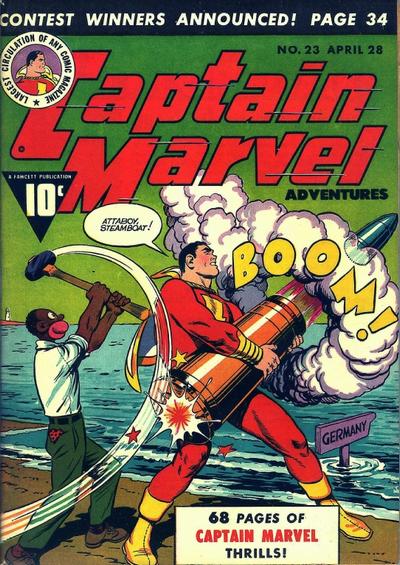
Comic books are made for entertainment purposes. To show us a world with super heroes who protect the good and fight the evil. Yet on one comic book cover I found did not live up to the entertainment. A cover like this, which is made for children, should have never been published.
The “Captain Marvel Adventure’s” comic book cover shows a white man in a super hero outfit holding a cannon. A black man banging the end with a hammer is triggering off the cannon. This picture, itself is disturbing. The white man is drawn to appear as superior with muscles bulging out of his costume tights. The black man is drawn to appear to look more like a monkey than a human being. The cannon is being shot in the direction of Germany, as told by the signs next to the cannon. This is another disturbing factor in the cover as this cover was clearly published during World War II. During a time in which black men and women were still discriminated against and yet the cover shows a black man helping a white man defeat the Germans.
Why did the author of the cover choose to draw this? The author of this cover chose to draw it like this because he wanted to make it seem as if the black man enjoyed helping the white man. He did this by drawing a smile on the black man’s face. The author used propaganda in this cover to help prove a statement that it is ok to help a white man. The author drew the white man superior to the black man. The black man was drawn with a smile on his face to make it seem like he enjoyed helping the white man.
I believe this cover is a counter-act to all the negativity on slavery at the time. The author wanted to prove a point that the black man on the cover was happy to help the white man. I have a problem with this cover because the children who look at this cover grow up to believe that it is ok for a black man to help him/her and there would not be a problem with it. Especially at a time when the nation had to come together during a time like World War II, this cover should have never of been published. The cover should have been drawn with both races as super heroes fighting along side one another. It is unfair to African-Americans who look at this because they too fought in the war and the cover does not justify that at all.
Wednesday, October 24, 2007
Takaki Chapter 10
In Chapter 10 of Takaki, “Pacific Crossings”, Japanese women were forced east to marry Japanese men who had already made their way across the Pacific Ocean. Through out the chapter, Takaki tells the hardships the Japanese women had to endure not only with being in a forceful marriage but living in a new world as well.
In the late 1800s, Japan’s economic system was not where it should have been. The Japanese were unable to pay taxes, especially the agricultural class. Many traveled east to Hawaii and to the rest of the United States. Some Japanese people traveled by their own choice, others were forced. The Japanese people that were forced were the women. They were forced across the Pacific to marry those Japanese men who were already settled. Back then, a Japanese marriage was arranged, and the bride did not have a say in who she wanted to marry. The Japanese women were more excited to experience America and get out of the hardships Japan was going through at the time. These Japanese women who were forced across the ocean to marry were called “picture brides”. Says one picture bride “My young heart, 19 years and 8 months old, burned, not so much with the prospects of reuniting with my new husband, but with the thought of the New World”. The Japanese women were used for not only marriage, but for labor as well. They were needed as workers for their new husbands. A researcher noted in 1915 that “The wives do much work in the fields”. The Japanese women were considered a type of slave, and more as an object that a human being.
Why the Japanese women? The Japanese women were very intelligent than any other race in that day. They were taught literature and a very young age and even knew English. This made the Japanese women easier to cooperate with and tolerate.
This reading was a difficult one to finish as it was one of our longer chapters this semester. It was disturbing reading what the Japanese women had to go through in their life. It is weird to think that back then men were supposed to be the care takers, and yet women were out in the fields contributing to all the hardwork.
In the late 1800s, Japan’s economic system was not where it should have been. The Japanese were unable to pay taxes, especially the agricultural class. Many traveled east to Hawaii and to the rest of the United States. Some Japanese people traveled by their own choice, others were forced. The Japanese people that were forced were the women. They were forced across the Pacific to marry those Japanese men who were already settled. Back then, a Japanese marriage was arranged, and the bride did not have a say in who she wanted to marry. The Japanese women were more excited to experience America and get out of the hardships Japan was going through at the time. These Japanese women who were forced across the ocean to marry were called “picture brides”. Says one picture bride “My young heart, 19 years and 8 months old, burned, not so much with the prospects of reuniting with my new husband, but with the thought of the New World”. The Japanese women were used for not only marriage, but for labor as well. They were needed as workers for their new husbands. A researcher noted in 1915 that “The wives do much work in the fields”. The Japanese women were considered a type of slave, and more as an object that a human being.
Why the Japanese women? The Japanese women were very intelligent than any other race in that day. They were taught literature and a very young age and even knew English. This made the Japanese women easier to cooperate with and tolerate.
This reading was a difficult one to finish as it was one of our longer chapters this semester. It was disturbing reading what the Japanese women had to go through in their life. It is weird to think that back then men were supposed to be the care takers, and yet women were out in the fields contributing to all the hardwork.
Monday, October 22, 2007
Living Jim Crow
In the reading “Wright/The Ethics of Living Jim Crow” I learned to value what I usually don’t, and that is my rights as a civilian. In the reading, there is a young African-American boy who grew up in Arkansas. The young boy experiences a very traumatic time in which he learns the hard way about Jim Crow Laws and how they will effect his everyday life.
The reading begins with the young African-American boy playing with his other black friends in the back of his yard. His yard is behind the railroad tracks and from time to time the black kids and white kids from across the tracks would get into, what the black boy thought was playful fights. The black kids would throw cinder barrage at the white kids, while the white kids would throw cinder barrage back. The playful fight took a turn for the worst as the white kids began throwing broken bottles they found lying around the tracks. The young black boy was hit in the back of an ear with a broken milk bottle and began bleeding profusely. The young boy was in so much pain and when he told his mother what happened she was more disappointed in him than the situation. She looked at the young boy’s wound and slapped him saying “How come yuh didn’t hide? How come yuh awways fightin?” The young boy was saddened and confused by the way his mom reacted. The young boy and his family moved from Arkansas to Mississippi. There the family resides in a black community, far from railroad tracks and white kids. The young boy is so accustomed to living in a black community and being treated like an equal that when it was time to find a job he knew it was going to be with white folks. The young boy received a job and was ridiculed. He was called the n-word like it was his name and when he took a break he was called “lazy”. His co-workers were behind all of the name calling even though they were the ones responsible for helping him learn his way around the job. One day the young boy was in the factory and was confronted by the co-workers. The co-workers made up a story about the boy calling a white man his last name without saying “mr.”. This was a great insult and the black boy would either have to agree to the story or be calling the white man a liar. He was screwed either way and pleaded to let him leave with out getting hurt and he’ll never return. The black boy got away and left the factory without a job.
Is there still racial tension in the workplace? I believe there is not, from my experiences so far in life. I worked in factory myself over the summer, and there I had the opportunity working with a black man and we really hit it off. We worked well together and learned about each other’s past. I have not heard of any racial tension in the work place through the media that I can think of. I believe as a society, we have come so far to not stoop as low as to the co-workers of the black boy in the reading.
I enjoyed this reading a lot. The more we continue this semester the more I am shocked by the stories that occurred in our own country. I think about how Jim Crow Laws were around only fifty years ago and it really makes me appreciate where we are as a country and how we treat others as equal.
The reading begins with the young African-American boy playing with his other black friends in the back of his yard. His yard is behind the railroad tracks and from time to time the black kids and white kids from across the tracks would get into, what the black boy thought was playful fights. The black kids would throw cinder barrage at the white kids, while the white kids would throw cinder barrage back. The playful fight took a turn for the worst as the white kids began throwing broken bottles they found lying around the tracks. The young black boy was hit in the back of an ear with a broken milk bottle and began bleeding profusely. The young boy was in so much pain and when he told his mother what happened she was more disappointed in him than the situation. She looked at the young boy’s wound and slapped him saying “How come yuh didn’t hide? How come yuh awways fightin?” The young boy was saddened and confused by the way his mom reacted. The young boy and his family moved from Arkansas to Mississippi. There the family resides in a black community, far from railroad tracks and white kids. The young boy is so accustomed to living in a black community and being treated like an equal that when it was time to find a job he knew it was going to be with white folks. The young boy received a job and was ridiculed. He was called the n-word like it was his name and when he took a break he was called “lazy”. His co-workers were behind all of the name calling even though they were the ones responsible for helping him learn his way around the job. One day the young boy was in the factory and was confronted by the co-workers. The co-workers made up a story about the boy calling a white man his last name without saying “mr.”. This was a great insult and the black boy would either have to agree to the story or be calling the white man a liar. He was screwed either way and pleaded to let him leave with out getting hurt and he’ll never return. The black boy got away and left the factory without a job.
Is there still racial tension in the workplace? I believe there is not, from my experiences so far in life. I worked in factory myself over the summer, and there I had the opportunity working with a black man and we really hit it off. We worked well together and learned about each other’s past. I have not heard of any racial tension in the work place through the media that I can think of. I believe as a society, we have come so far to not stoop as low as to the co-workers of the black boy in the reading.
I enjoyed this reading a lot. The more we continue this semester the more I am shocked by the stories that occurred in our own country. I think about how Jim Crow Laws were around only fifty years ago and it really makes me appreciate where we are as a country and how we treat others as equal.
Monday, October 15, 2007
Zinn Chapter 9
Throughout our lives we have always been taught by teachers, parents, and friends to stand up for what you believe in and for what you believe is right. We live in a country where we have a right of freedom of speech, and to express ourselves anyway we wish. So when I read Zinn Chapter 9, I was very shocked at the way the rebellious slaves were treated.
Zinn Chapter 9 starts off with explaining how successful the plantation fields were in the 1800s. In 1808, a law was passed to illegalize the imporation of slaves in the United States. However, this law did not prevent plantation owners to keep goin on with their business. “From the beginning, the law went unenforced,” says John Hope Frankline. They realized how hard of workers the African-Americans were and continued on importing slaves into their plantations. This success was because of the hard work the African-American slaves put in day in and day out. Between tobacco, cotton, and rice, African-American slaves were benefiting the white economy in the early years of the United States. However, the African-Americans hard work would not benefit the African-Americans. Slave revolts were not common in the United States because of the fear of the unexpected. However the when the largest slave revolt did occur in the United States, there were great consequences. In the year 1811, near present day New Orleans, four to five hundred slaves came together after a rising at a plantation. With cane knives, axes, and clubs in hand the slaves began marching from plantation to plantation. Along the march, their number began to increase more and more. The slave revolt was eventually attacked by the United States Army. Out of the slave revolt, sixty-six were killed on the spot and another sixteen were tried and killed.
How could the plantation owners continue with the importing of the slaves even after a law was passed to prohibit such a thing? The plantation owners were well aware of the law but they were too greedy to follow it. John Hope Franklin was quoted saying “The long, unprotected coast, the certain markets, and the prospects of huge profits were too much for the American merchants and they yielded to the temptation…”.
Although this reading was one of the more difficult ones to finish, I enjoyed what Zinn had to say. I believe the way he writes and paints a picture in your head as you read, benefits him as a writer. However, I was surprised to see the plantation owner’s actions and how they suffered no consequences yet the African-Americans slaves are the ones who are punished and killed.
Zinn Chapter 9 starts off with explaining how successful the plantation fields were in the 1800s. In 1808, a law was passed to illegalize the imporation of slaves in the United States. However, this law did not prevent plantation owners to keep goin on with their business. “From the beginning, the law went unenforced,” says John Hope Frankline. They realized how hard of workers the African-Americans were and continued on importing slaves into their plantations. This success was because of the hard work the African-American slaves put in day in and day out. Between tobacco, cotton, and rice, African-American slaves were benefiting the white economy in the early years of the United States. However, the African-Americans hard work would not benefit the African-Americans. Slave revolts were not common in the United States because of the fear of the unexpected. However the when the largest slave revolt did occur in the United States, there were great consequences. In the year 1811, near present day New Orleans, four to five hundred slaves came together after a rising at a plantation. With cane knives, axes, and clubs in hand the slaves began marching from plantation to plantation. Along the march, their number began to increase more and more. The slave revolt was eventually attacked by the United States Army. Out of the slave revolt, sixty-six were killed on the spot and another sixteen were tried and killed.
How could the plantation owners continue with the importing of the slaves even after a law was passed to prohibit such a thing? The plantation owners were well aware of the law but they were too greedy to follow it. John Hope Franklin was quoted saying “The long, unprotected coast, the certain markets, and the prospects of huge profits were too much for the American merchants and they yielded to the temptation…”.
Although this reading was one of the more difficult ones to finish, I enjoyed what Zinn had to say. I believe the way he writes and paints a picture in your head as you read, benefits him as a writer. However, I was surprised to see the plantation owner’s actions and how they suffered no consequences yet the African-Americans slaves are the ones who are punished and killed.
Monday, October 1, 2007
Kindred Post 1
We hear the “n-word” thrown out a lot in today’s society. When we hear this word it is almost always in a movie or a comedy show. When the “n-word” comes up it is used in a non-serious, joking manner. As I was reading Kindred, it was shocking to read how two hundred years ago the “n-word” was used in a totally different way.
Kindred starts off in Dana’s house helping her husband unpack some books. Dana begins to feel light headed and the room starting to move. She realizes furniture disappearing and all of sudden she collapses into a woods near a river where there is a young boy drowning. Dana, not thinking where she is or how she got there, rushes to the young boy’s aid. Upon pulling the young boy out of the water there is a white woman, the young boy’s mother, running and screaming for her son’s life. She is blaming Dana for killing her baby and takes out her anger on Dana by hitting her in the shoulder. Dana refuses to give up on the young boy’s life and pushes the white woman away and begins performing mouth to mouth on the young boy. The boy begins to breathe on his own and upon turning around there is a man with a long rifle pointed at Dana. Dana then vanishes back to where she began the chapter with her husband. Upon arriving back home she frightened with her husband by her side. Not knowing what had just happened she opts to stay home and not go outside. At the dinner table she begins to feel the same way she did the last time she vanished. The room starts disappearing and she collapses in a room with the same young boy, who is now a couple years older. The young boy was trying to start his house on fire to take away all of his father’s money. Dana rescues the young boy and the house by preventing the fire from starting. Dana begins to talk to the young boy with whom he refers to her as the “n-word”. He recalls the time where he was drowning and Dana came to his aid. His mom was hesitant to allow Dana near him to help save him because Dana was a “n-word”.
What is the “n-word” in today’s society? I believe that word is used in a joking manner only for those who are allowed to say it. The African-Americans in today’s society use the word the most and actually refer to each other as it. You will never see a member of the opposite race say the “n-word” without some sort of punishment or action being followed.
I believe the “n-word” is a very sensible subject for African-Americans. If they want to use that word and refer to each other as that then that is fine, it is up to them. It is a word that was used to downgrade them in the early years of America. Never should a member of the opposite race feel the need to say it in reference to an African-American. It is wrong and there is no place for it in today’s society.
Kindred starts off in Dana’s house helping her husband unpack some books. Dana begins to feel light headed and the room starting to move. She realizes furniture disappearing and all of sudden she collapses into a woods near a river where there is a young boy drowning. Dana, not thinking where she is or how she got there, rushes to the young boy’s aid. Upon pulling the young boy out of the water there is a white woman, the young boy’s mother, running and screaming for her son’s life. She is blaming Dana for killing her baby and takes out her anger on Dana by hitting her in the shoulder. Dana refuses to give up on the young boy’s life and pushes the white woman away and begins performing mouth to mouth on the young boy. The boy begins to breathe on his own and upon turning around there is a man with a long rifle pointed at Dana. Dana then vanishes back to where she began the chapter with her husband. Upon arriving back home she frightened with her husband by her side. Not knowing what had just happened she opts to stay home and not go outside. At the dinner table she begins to feel the same way she did the last time she vanished. The room starts disappearing and she collapses in a room with the same young boy, who is now a couple years older. The young boy was trying to start his house on fire to take away all of his father’s money. Dana rescues the young boy and the house by preventing the fire from starting. Dana begins to talk to the young boy with whom he refers to her as the “n-word”. He recalls the time where he was drowning and Dana came to his aid. His mom was hesitant to allow Dana near him to help save him because Dana was a “n-word”.
What is the “n-word” in today’s society? I believe that word is used in a joking manner only for those who are allowed to say it. The African-Americans in today’s society use the word the most and actually refer to each other as it. You will never see a member of the opposite race say the “n-word” without some sort of punishment or action being followed.
I believe the “n-word” is a very sensible subject for African-Americans. If they want to use that word and refer to each other as that then that is fine, it is up to them. It is a word that was used to downgrade them in the early years of America. Never should a member of the opposite race feel the need to say it in reference to an African-American. It is wrong and there is no place for it in today’s society.
Wednesday, September 26, 2007
Takaki Chapter 3
After reading Takaki Chapter 3 I was troubled by the way he went in depth with the difference between black slaves and white servants. I never knew that white servants and black slaves were treated so differently. Takaki also discussed the different ethnic class in the early years of the United States of America. I never believed that one of our presidents was a slave owner himself in Thomas Jefferson. Thomas Jefferson was also talked about as a founding father who would never believe blacks and whites could co-exist.
With the help of a Shakespeare play, “The Tempest”, Takaki informs us of how in that time slaves were looked down upon in both the way they looked and the way they acted. Takaki gives us instances of when a black and white had relations and were punished because it was a forbidden encounter. Takaki then goes into detail on the difference between white servants and black slaves. Slaves were seen as objects rather than humans. They were valuable to the white slave owner and to his profit. Whereas white servants were forced to work for a short number of time. Takaki gives an example of a man who believed the same thing about whites and blacks, Thomas Jefferson. He believed whites and blacks could never get along although he argued against the use of slavery and wanted to abolish it all together in the United States. Takaki then goes into detail on the different types of white classes in the early years of America. There were so many white people but little actually owned land, which caused friction through out the classes. For instance, in the north east several militias were set up to protect the property from new travelers overseas. Another example is how some classes feared that the lesser well off classes would take sides with the enemy in spite of their riches.
How is it fair that white servants were treated differently than black slaves? It is not fair at all. Both are forms of slavery and it ridiculous that race is an excuse for the way the servants and slaves are treated differently. Takaki described in Chapter 3 that because of the fact that the black slaves were uncivilized and non Christian they were not seen as high up as white servants. The African Americans were not seen as human but only an object were the white servants were still treated with respect.
I learned a lot about reading Takaki Chapter 3. I was interesting to me to read about the difference between black slaves and white servants. I just don’t understand how people can be so ignorant and selfish to treat someone the way they were treated. It is very troubling to go on with these readings because of that. Yet, this was probably the reading I enjoyed the most because the information was new to me and interesting.
With the help of a Shakespeare play, “The Tempest”, Takaki informs us of how in that time slaves were looked down upon in both the way they looked and the way they acted. Takaki gives us instances of when a black and white had relations and were punished because it was a forbidden encounter. Takaki then goes into detail on the difference between white servants and black slaves. Slaves were seen as objects rather than humans. They were valuable to the white slave owner and to his profit. Whereas white servants were forced to work for a short number of time. Takaki gives an example of a man who believed the same thing about whites and blacks, Thomas Jefferson. He believed whites and blacks could never get along although he argued against the use of slavery and wanted to abolish it all together in the United States. Takaki then goes into detail on the different types of white classes in the early years of America. There were so many white people but little actually owned land, which caused friction through out the classes. For instance, in the north east several militias were set up to protect the property from new travelers overseas. Another example is how some classes feared that the lesser well off classes would take sides with the enemy in spite of their riches.
How is it fair that white servants were treated differently than black slaves? It is not fair at all. Both are forms of slavery and it ridiculous that race is an excuse for the way the servants and slaves are treated differently. Takaki described in Chapter 3 that because of the fact that the black slaves were uncivilized and non Christian they were not seen as high up as white servants. The African Americans were not seen as human but only an object were the white servants were still treated with respect.
I learned a lot about reading Takaki Chapter 3. I was interesting to me to read about the difference between black slaves and white servants. I just don’t understand how people can be so ignorant and selfish to treat someone the way they were treated. It is very troubling to go on with these readings because of that. Yet, this was probably the reading I enjoyed the most because the information was new to me and interesting.
Monday, September 17, 2007
Chapter 8 of Johnson
In Chapter 8 of Johnson: “Getting Off the Hook: Denial and Resistance” the author goes into detail on how today’s society uses denial and blame to make events in life look better than what they really are.
In Chapter 8 the author states that “no one likes to see themselves as connected to someone else’s misery, no matter how remote the link”. (108) Not only is denial a problem but minimization of the trouble by acknowledging that it exists but then claiming that it does not amount to anything is just as big a problem. When people in dominant groups such as white males practice denial, it hardly seems to occur to them that they are in a poor situation to know exactly what they are talking about. If a dominant group acts like they know better than others do about what they are up against is just the kind of problem society is facing. Denial is also seen as taking the form of having lesser known groups actually being better off than dominant groups. “One can acknowledge that terrible things happen to people and still get off the hook by blaming it all on them” (110) The result of putting blame on others is that it is putting blame on the people who suffer most from it, while the more dominant groups are not effected. The combination of denial and minimization often results in the claim that everyone in today’s society actually likes things the way they are.
How can others stay away from denial and minimization? I believe that denial, minimization, and blaming others will always be around. We must understand as a society that even though this corrupt way of thinking will probably be around for the long run, we should still try to do what is right and look past the way others get by in life. We must not stoop to people’s levels who think this way that it is alright to blame others for ones own actions.
I enjoyed this chapter a lot because of the way the author gave specific examples in which we encounter and probably gone through in every day life. I learned a lot about not only how our society works but how you must look out for yourself because there are people out there who will want nothing more than to run you over.
In Chapter 8 the author states that “no one likes to see themselves as connected to someone else’s misery, no matter how remote the link”. (108) Not only is denial a problem but minimization of the trouble by acknowledging that it exists but then claiming that it does not amount to anything is just as big a problem. When people in dominant groups such as white males practice denial, it hardly seems to occur to them that they are in a poor situation to know exactly what they are talking about. If a dominant group acts like they know better than others do about what they are up against is just the kind of problem society is facing. Denial is also seen as taking the form of having lesser known groups actually being better off than dominant groups. “One can acknowledge that terrible things happen to people and still get off the hook by blaming it all on them” (110) The result of putting blame on others is that it is putting blame on the people who suffer most from it, while the more dominant groups are not effected. The combination of denial and minimization often results in the claim that everyone in today’s society actually likes things the way they are.
How can others stay away from denial and minimization? I believe that denial, minimization, and blaming others will always be around. We must understand as a society that even though this corrupt way of thinking will probably be around for the long run, we should still try to do what is right and look past the way others get by in life. We must not stoop to people’s levels who think this way that it is alright to blame others for ones own actions.
I enjoyed this chapter a lot because of the way the author gave specific examples in which we encounter and probably gone through in every day life. I learned a lot about not only how our society works but how you must look out for yourself because there are people out there who will want nothing more than to run you over.
Chapter 6 of Johnson
The social norm in today’s society was discussed in Chapter 6 of Johnson. What is the social norm? Many believe that being a straight, white, male is the norm because we have supposedly done the most in this world. But what really is the social norm in today’s society? Does if have to be a straight, white, male? Chapter 6 of Johnson discusses these questions.
In Chapter 6 of Johnson it is said that as we participate in social systems, we are shaped as individual people. Through socialization we learn to participate in life, whether it is in school, religion, or our family. We learn by examples set for us by coaches, teachers, and peers. Examples that teach us what is right and what is wrong, value this over that, and what is considered accepted and what is not. Through all of that we develop a sense of identity and how that identity positions itself with other people of gender, race, and ethnic background. Our identity has developed though out our life since we were little. We know that there are other alternatives but we are too scared to believe in anything else but the norm. We are too scared to go against what we were taught our whole lives and to go against what today’s society believes is correct.
Is socialization the reason why I believe in what believe in today? I agree with what Chapter 6 of Johnson said. For as early as I can remember I have been surrounded by people telling me their experiences and what the feel is right. The foundation of socialization comes for out parents. If our parents brought us up the way they did then there is a good chance that we both believe in the same type of things. From coaches to teachers they all try to lecture us with what the think is the norm. I was brought up Roman Catholic. My parents took me to church every Sunday and put me through Catholic grade school and Catholic high school. Because of that upbringing, I believe is the reason why I am a devout believer in the Roman Catholic Church today.
In Chapter 6 of Johnson I realized that I am who I am today because of those around me. Thank God I was surrounded with people with good values and morals. People who cared for me and my overall look on life. Others are not that fortunate. Others are brought up with racist parents and are brought up with wrong values and morals. Today, I believe our society does not have overall healthy morals and values but if my generation brings our children up with what is the right norm then our society will change for the better.
In Chapter 6 of Johnson it is said that as we participate in social systems, we are shaped as individual people. Through socialization we learn to participate in life, whether it is in school, religion, or our family. We learn by examples set for us by coaches, teachers, and peers. Examples that teach us what is right and what is wrong, value this over that, and what is considered accepted and what is not. Through all of that we develop a sense of identity and how that identity positions itself with other people of gender, race, and ethnic background. Our identity has developed though out our life since we were little. We know that there are other alternatives but we are too scared to believe in anything else but the norm. We are too scared to go against what we were taught our whole lives and to go against what today’s society believes is correct.
Is socialization the reason why I believe in what believe in today? I agree with what Chapter 6 of Johnson said. For as early as I can remember I have been surrounded by people telling me their experiences and what the feel is right. The foundation of socialization comes for out parents. If our parents brought us up the way they did then there is a good chance that we both believe in the same type of things. From coaches to teachers they all try to lecture us with what the think is the norm. I was brought up Roman Catholic. My parents took me to church every Sunday and put me through Catholic grade school and Catholic high school. Because of that upbringing, I believe is the reason why I am a devout believer in the Roman Catholic Church today.
In Chapter 6 of Johnson I realized that I am who I am today because of those around me. Thank God I was surrounded with people with good values and morals. People who cared for me and my overall look on life. Others are not that fortunate. Others are brought up with racist parents and are brought up with wrong values and morals. Today, I believe our society does not have overall healthy morals and values but if my generation brings our children up with what is the right norm then our society will change for the better.
Chapter 3 of Johnson
The term Capitalism is an economic system in which investment in an ownership of the means of production, distribution, and exchange of wealth is made and maintained by individuals or corporations. Capitalism was around during the time of the civil war and is still around today in 2007. Capitalism is something that everyone looks at as relating to stocks or money, never would anyone relate it to slavery. In Chapter 3 of Johnson, capitalism is looked at as a cause of slavery then and now.
In the history of the United States capitalism has played a part in racism. Even before the Civil War, white plantation owners would use capitalism to make a profit for themselves. African American slaves were used for cheap labor on cotton and tobacco plantations in the south. The African American slaves were used for economic reasons. Planters chose to minimize labor costs by using slaves instead of paying free workers a living wage. Even after the Civil War in 1860, capitalism controlled the African Americans. A way capitalism was used to control workers was to keep them worried over the possibility of losing their job for complaining about their working conditions or asking for higher wages.
Does capitalism still play a part in racism today? I do not believe capitalism plays a role in racism in today’s society. With minorities beginning to earn more and become wealthy, they also have been taking part in capitalism. Capitalism today is not what it was in the 1800s. Capitalism today does not cause hardship as it did back then and even though in terms of trying to make a profit, it is done in the right way. In Chapter 3 of Johnson I realized that capitalism was used as a way for white plantation owners to make a buck. Money and greed went to their heads and instead of thinking for other people like the African American slaves they thought of the profit they would receive in return.
I believe capitalism was a corrupt system. One that gave a black eye to the United States of America for causing racial discrimination in our country. Today, I believe it has changed for the better. Even though capitalism brings along pride, competition, and profit in return for a better living for ones family, I believe it is done the right and correct way.
In the history of the United States capitalism has played a part in racism. Even before the Civil War, white plantation owners would use capitalism to make a profit for themselves. African American slaves were used for cheap labor on cotton and tobacco plantations in the south. The African American slaves were used for economic reasons. Planters chose to minimize labor costs by using slaves instead of paying free workers a living wage. Even after the Civil War in 1860, capitalism controlled the African Americans. A way capitalism was used to control workers was to keep them worried over the possibility of losing their job for complaining about their working conditions or asking for higher wages.
Does capitalism still play a part in racism today? I do not believe capitalism plays a role in racism in today’s society. With minorities beginning to earn more and become wealthy, they also have been taking part in capitalism. Capitalism today is not what it was in the 1800s. Capitalism today does not cause hardship as it did back then and even though in terms of trying to make a profit, it is done in the right way. In Chapter 3 of Johnson I realized that capitalism was used as a way for white plantation owners to make a buck. Money and greed went to their heads and instead of thinking for other people like the African American slaves they thought of the profit they would receive in return.
I believe capitalism was a corrupt system. One that gave a black eye to the United States of America for causing racial discrimination in our country. Today, I believe it has changed for the better. Even though capitalism brings along pride, competition, and profit in return for a better living for ones family, I believe it is done the right and correct way.
Chapter 2 of Johnson
In Chapter 2 of Johnson: “Privilege, Oppression and Difference” starts off by expressing the differences in race and gender and the problems and troubles that come with it. He states that “The trouble that surrounds difference is really about privilege and power.” It is clear that in Chapter 2 the point that wants to come across is that we must stop ignoring privileges and believing that difference itself is the problem.
In the beginning of the chapter Johnson uses a “diversity wheel” that labels social characteristics to make a point. In the “diversity wheel” there are six social characteristics including age, race, ethnicity, gender, physical ability, and qualities such as being left or right handed. On the outer side of the wheel there are several other social characteristics including religion, marital status, education, occupation, and income. Johnson answered the questions in the “diversity wheel” himself and then suggested to the reader stopping reading and do the same thing. The answers I came up with were that I am a 19 year old white male who is right handed. I believe in the Roman Catholic religion, I am single, I am unemployed and still in college. Upon answering the questions Johnson then wanted us to change one answer of ours into something opposite. After changing our answer he wanted us to think to ourselves if we would then be treated any differently by society.
Would society treat an individual different just because of one change in a social characteristic? I believe the society we live in today would treat an individual different because of a change in social characteristics. If I would wake up tomorrow and be a black homosexual male instead of a white heterosexual male, I believe people would treat me differently. If I so happened to wake up a black homosexual male tomorrow morning and put on my usual clothes and talked the same way I do now I believe I would be treated differently. Not just because of the color of my skin but because black people usually do not dress or talk the way I do now. I believe not only society would treat my different but maybe my own friends and family would as well. Opportunities that were once open to me I believe would close due to the fact that not only is society uncomfortable around homosexuals, society is still not open to blacks the way that it should be.
Chapter 2 of Johnson: “Privilege, Oppression and Difference” really made me think about the way our society is still not where it needs to be. To think that if only one social characteristic would change about me out of all of them I would be judged and treated differently makes me upset. Our society is so judgmental not only on race but on gender, physical ability, and income. Our society believes what it thinks is right and it is never right.
In the beginning of the chapter Johnson uses a “diversity wheel” that labels social characteristics to make a point. In the “diversity wheel” there are six social characteristics including age, race, ethnicity, gender, physical ability, and qualities such as being left or right handed. On the outer side of the wheel there are several other social characteristics including religion, marital status, education, occupation, and income. Johnson answered the questions in the “diversity wheel” himself and then suggested to the reader stopping reading and do the same thing. The answers I came up with were that I am a 19 year old white male who is right handed. I believe in the Roman Catholic religion, I am single, I am unemployed and still in college. Upon answering the questions Johnson then wanted us to change one answer of ours into something opposite. After changing our answer he wanted us to think to ourselves if we would then be treated any differently by society.
Would society treat an individual different just because of one change in a social characteristic? I believe the society we live in today would treat an individual different because of a change in social characteristics. If I would wake up tomorrow and be a black homosexual male instead of a white heterosexual male, I believe people would treat me differently. If I so happened to wake up a black homosexual male tomorrow morning and put on my usual clothes and talked the same way I do now I believe I would be treated differently. Not just because of the color of my skin but because black people usually do not dress or talk the way I do now. I believe not only society would treat my different but maybe my own friends and family would as well. Opportunities that were once open to me I believe would close due to the fact that not only is society uncomfortable around homosexuals, society is still not open to blacks the way that it should be.
Chapter 2 of Johnson: “Privilege, Oppression and Difference” really made me think about the way our society is still not where it needs to be. To think that if only one social characteristic would change about me out of all of them I would be judged and treated differently makes me upset. Our society is so judgmental not only on race but on gender, physical ability, and income. Our society believes what it thinks is right and it is never right.
Thursday, September 6, 2007
Race: The Power of Illusion
The movie Race: The Power of Illusion investigated race in society, science, and history. Why are black athletes always the biggest, fastest, and strongest? This movie goes above and beyond answering this question. This movie answered everything from experimenting on bone structures, to class projects on each other’s DNA, to truly finding out if black people have an extra bone in their leg. All the questions I have asked myself my whole life about the opposite race were answered.
The start of the movie takes place in a classroom where the students will participate in a DNA experiment. The DNA experiment is to teach the class a lesson that even though on the outside it looks like we are so different; on the inside we are so much alike. Before the experiment began they were to write down who they thought they were most alike in the class. Naturally, the Asians picked other Asians, African Americans chose other African Americans, and whites decided to pick other whites through out the class. The class is made up of African American athletes to Asian string players. The students in the class are surprised when they discover their closest genetic matches are as likely to be with people from other races as their own. They are stunned to realize that an African American female track star is more similar to an Asian male violinist than to another African American female athlete. A white male is shocked to find out that not only is he genetically matched to his eastern European roots, he is also genetically matched to an African male in Nigeria. The movie continues on with the myth of the extra bone in an African American leg. This myth couldn’t be farther from the truth. After Jesse Owens won gold in the 1937 Olympics he was studied and examined. Not one thing was found out of the ordinary that could distinguish him from a white male.
How different are we from other races? The truth is we are not different at all. We are similar to every race in the world. From African American, Asian, Indian, to Caucasian we are all genetically matched. Inside all of use we are all the same, there are not extra bones in some races and not others. The only thing that divides us in the minds of others is the color of our skin, and even that can be explained. The color of our skin is the result of where are ancestors were located and vitamin D from the sun. We are all the same no matter what color we are or how our hair looks.
I learned a lot about the movie Race: The Power of Illusion. I enjoyed watching the class learn more and more about the results from the DNA test. I could tell from the expression on their faces that they were not expecting the answer they had received. It is hard to except the fact that even though we are all genetically similar then why did so many die before us? It is very sad to think that so many lives were lost because we really did believe we were different of those with different skin color. Now we know the truth and should make an attempt to tell those who don’t believe the same that we are all truly the identical.
The start of the movie takes place in a classroom where the students will participate in a DNA experiment. The DNA experiment is to teach the class a lesson that even though on the outside it looks like we are so different; on the inside we are so much alike. Before the experiment began they were to write down who they thought they were most alike in the class. Naturally, the Asians picked other Asians, African Americans chose other African Americans, and whites decided to pick other whites through out the class. The class is made up of African American athletes to Asian string players. The students in the class are surprised when they discover their closest genetic matches are as likely to be with people from other races as their own. They are stunned to realize that an African American female track star is more similar to an Asian male violinist than to another African American female athlete. A white male is shocked to find out that not only is he genetically matched to his eastern European roots, he is also genetically matched to an African male in Nigeria. The movie continues on with the myth of the extra bone in an African American leg. This myth couldn’t be farther from the truth. After Jesse Owens won gold in the 1937 Olympics he was studied and examined. Not one thing was found out of the ordinary that could distinguish him from a white male.
How different are we from other races? The truth is we are not different at all. We are similar to every race in the world. From African American, Asian, Indian, to Caucasian we are all genetically matched. Inside all of use we are all the same, there are not extra bones in some races and not others. The only thing that divides us in the minds of others is the color of our skin, and even that can be explained. The color of our skin is the result of where are ancestors were located and vitamin D from the sun. We are all the same no matter what color we are or how our hair looks.
I learned a lot about the movie Race: The Power of Illusion. I enjoyed watching the class learn more and more about the results from the DNA test. I could tell from the expression on their faces that they were not expecting the answer they had received. It is hard to except the fact that even though we are all genetically similar then why did so many die before us? It is very sad to think that so many lives were lost because we really did believe we were different of those with different skin color. Now we know the truth and should make an attempt to tell those who don’t believe the same that we are all truly the identical.
Drawing the Color Line
In chapter 2 “Drawing the Color Line”, Howard Zinn states that “there is not a country in the world history in which racism has been more important for so long a time, as the United States” (P23). Howard Zinn answers many of the questions we are asking ourselves today. Why do we have race? How did it start and when will it end? Zinn takes us back to the English colonies where slavery begins to label a difference between whites and blacks.
From the very beginning the black men and woman tried everything to resist their enslavement. From running away to organizing rebellious actions, the blacks would try anything to keep their dignity as human beings. The punishment was death for those caught trying to run away and yet nothing stopped them as they tried to keep their tribal heritage alive. It was a powerful system of control that the slave owners developed to try to maintain their way of life. The slaves were taught to obey the master and to “know their place” (29). They were told that being black was less-fortunate. The slave owners used a psychological and physical system to break down the slaves. They made them weak internally by breaking up their families and making them believe there was no hope. They also made them physically weak by whipping, burning, and sometimes even killing. Yet even after all of that some still escaped. Not a lot but enough to keep the white slave owners living in fear.
When will black segregation end? I believe we have made strides throughout the past fifty years on black segregation. Since the 1960s whites and blacks were given the same rights even though people today still do not support not respect it. For those people who judge people by their color even today is hard to believe. Racism is based on history and happened when America was young and stupid. The type of racism that existed in the 1700s does not exist in 2007. Black segregation has ended as far as I am concerned; we are equal in one country.
I was already familiar with how the slaves were treated but to read about it and how they suffered not just physically but mentally really touched me. It is amazing to see how far we have grown and matured as a country in the past generation. To think twenty years before I was born segregation was still going on is mind boggling and stunning. I was stunned to read how many slaves died not only because of the treatment from the slave owners but being transported to the plantations as well.
From the very beginning the black men and woman tried everything to resist their enslavement. From running away to organizing rebellious actions, the blacks would try anything to keep their dignity as human beings. The punishment was death for those caught trying to run away and yet nothing stopped them as they tried to keep their tribal heritage alive. It was a powerful system of control that the slave owners developed to try to maintain their way of life. The slaves were taught to obey the master and to “know their place” (29). They were told that being black was less-fortunate. The slave owners used a psychological and physical system to break down the slaves. They made them weak internally by breaking up their families and making them believe there was no hope. They also made them physically weak by whipping, burning, and sometimes even killing. Yet even after all of that some still escaped. Not a lot but enough to keep the white slave owners living in fear.
When will black segregation end? I believe we have made strides throughout the past fifty years on black segregation. Since the 1960s whites and blacks were given the same rights even though people today still do not support not respect it. For those people who judge people by their color even today is hard to believe. Racism is based on history and happened when America was young and stupid. The type of racism that existed in the 1700s does not exist in 2007. Black segregation has ended as far as I am concerned; we are equal in one country.
I was already familiar with how the slaves were treated but to read about it and how they suffered not just physically but mentally really touched me. It is amazing to see how far we have grown and matured as a country in the past generation. To think twenty years before I was born segregation was still going on is mind boggling and stunning. I was stunned to read how many slaves died not only because of the treatment from the slave owners but being transported to the plantations as well.
About Me
My name is Lee Marquette. I am 19 years old and I am from Rossford, Ohio. I am currently in the Air National Guard and a sophomore at Bowling Green State University. I went to High school at Toledo Central Catholic. I played football and won the State Championship my senior year in Division II. I chose BGSU because it was close to home and family means a lot to me. I plan on majoring in Marketing and hopefully in only 4 years. I love watching movies in my free time. My all time favorite is Casino Royale. I am a big sports fanatic, my favorite team is the New England Patriots. I enjoy being active and try to break a sweat at least once a day. My girlfriend and I have been dating since our junior year at Central. She got a scholarship at the University of Georgia so I travel down south whenever I get the chance.
Monday, August 27, 2007
Takaki Ch.2
We recognize our United States of America as the greatest country in the world. A nation that defends freedom and gives us the opportunity to live our lives the way we choose. That definition of our great country made this assignment somewhat difficult. Thomas Jefferson is known as one of the founding fathers of the United States and even served as president. The “Tempest” made me think of how America gives us the opportunity to live our lives the way we choose and I was curious as to why Jefferson did not give the Native Americans the same choice.
Buy the 1760s, thousands of Europeans had made their way across the Atlantic to the shores of America and begun establishing their way of live. However, what was the way of life to the Europeans was far from how the Native Americans lived theirs. The Native Americans began to grow unsure about their future, as the Europeans were ecstatic about theirs. Jefferson was governor of Virginia at the time and tried to create a friendship with them. Jefferson thought they were both “Americans, born in the same land”. Despite the building bond between the two, Jefferson secretly wanted to civilize the Native Americans. Making them abandon hunting and switch to agriculture. The land the Native Americans owned was also an issue to Jefferson. With the ever growing population of the whites in America, Jefferson planned to pressure Native Americans into selling. Jefferson tried to destroy them financially by favoring federal over private trading houses. His tactics worked, either the Native Americans would convert into a civilian or retreat out west.
We discussed in class how Christopher Columbus wasn’t the man we all thought he was. He was still a great explorer but far from the hero we all made him out to be. I feel a little of the same towards Thomas Jefferson. Jefferson, the third president of the United States, was a founding father, a man who wrote the Declaration of Independence. So it is just so hard for me to believe and even try to understand what his motives were in the way he forced the Native Americans out. I’m sure I am being a little too strong because the time was different back then and we really can’t put ourselves into someone else’s position. However, Columbus and Jefferson have a lot in common. The way greed took over Columbus for fame drove him to start a mass genocide. Jefferson was maybe driven by starting a new and young country off on what he thought was right. I am not taking anything away from Thomas Jefferson, he is a pioneer, but I believe he could of handled situations a lot better concerning the Native Americans.
The “Tempest” was a difficult read for me than others may think. I am a member of the United States Air Force and when I swore in I swore to serve and protect against all those who threatened our freedom. Where was the Native American’s freedom? Why didn’t they have a right to live the way they wanted to live? I can’t help but feel sorry for the Native Americans and can only imagine what life would be like if people like Columbus and Jefferson would of handled their situations differently.
Buy the 1760s, thousands of Europeans had made their way across the Atlantic to the shores of America and begun establishing their way of live. However, what was the way of life to the Europeans was far from how the Native Americans lived theirs. The Native Americans began to grow unsure about their future, as the Europeans were ecstatic about theirs. Jefferson was governor of Virginia at the time and tried to create a friendship with them. Jefferson thought they were both “Americans, born in the same land”. Despite the building bond between the two, Jefferson secretly wanted to civilize the Native Americans. Making them abandon hunting and switch to agriculture. The land the Native Americans owned was also an issue to Jefferson. With the ever growing population of the whites in America, Jefferson planned to pressure Native Americans into selling. Jefferson tried to destroy them financially by favoring federal over private trading houses. His tactics worked, either the Native Americans would convert into a civilian or retreat out west.
We discussed in class how Christopher Columbus wasn’t the man we all thought he was. He was still a great explorer but far from the hero we all made him out to be. I feel a little of the same towards Thomas Jefferson. Jefferson, the third president of the United States, was a founding father, a man who wrote the Declaration of Independence. So it is just so hard for me to believe and even try to understand what his motives were in the way he forced the Native Americans out. I’m sure I am being a little too strong because the time was different back then and we really can’t put ourselves into someone else’s position. However, Columbus and Jefferson have a lot in common. The way greed took over Columbus for fame drove him to start a mass genocide. Jefferson was maybe driven by starting a new and young country off on what he thought was right. I am not taking anything away from Thomas Jefferson, he is a pioneer, but I believe he could of handled situations a lot better concerning the Native Americans.
The “Tempest” was a difficult read for me than others may think. I am a member of the United States Air Force and when I swore in I swore to serve and protect against all those who threatened our freedom. Where was the Native American’s freedom? Why didn’t they have a right to live the way they wanted to live? I can’t help but feel sorry for the Native Americans and can only imagine what life would be like if people like Columbus and Jefferson would of handled their situations differently.
Zinn Chapter 1
All my life I grew up being taught that Christopher
Columbus was an amazing man and an even better explorer. He
was the man who believed the world was round and not flat. He
was the man who discovered the America we live in today.
However, after reading Columbus, the Indians, and Human
Progress by Howard Zinn my opinion of this so called hero has
somewhat changed. Christopher Columbus is not the legendary
man I learned about growing up but a man who’s greed of gold
caused him to end the existence of a peaceful Arawak tribe.
Thirty-three days after leaving Spain’s shores and
sailing east, Columbus and his thirty-nine men began to see
signs of land. With flocks of birds above them and twigs and
branches in the water beneath them they discovered land in the
early morning of October 12. As Columbus and his men anxiously
approached the shore they noticed they weren’t the only ones on
the land. They were approached by the Arawak Indian tribe who
graciously swam out to greet the Europeans. The Arawak Indians
were a peaceful tribe who lived in villages just off the coast
of the Caribbean water. Columbus not only noticed the lack of
protection they had but also the gold they wore hanging from
their ears. This caused the Spaniard to take capture some of
the Arawak in search for more of the gold. The Europeans went
from island to island in search for gold. Reporting back to
Spain, Columbus promised gold and slaves in return for
investment in more ships and more men. Columbus’ greed for
gold grew as he and his men began to take prisoners and killed
those who disobeyed. The Europeans began to run out of gold
fields and ran into empty villages as they searched for riches
and slaves. In a desperate move in order to fill the ships
with something instead of gold, Columbus captured 1500 Arawak
men, women, and children. As time went on a majority of the
1500 died of disease and harsh living conditions. In a panic
move, Columbus ordered the remaining slaves an impossible task.
They were to gather as much gold around them as they could even
though the remaining gold was nothing but bits and dust. The
Arawaks tried to resist, instead they faced the Europeans who
had horses, armor, and muskets compared to the Indians bow and
arrows. In result of the defeat, many died due to suicides in
order to save themselves from the Europeans. When realizing
there was no gold left to be discovered the remaining Arawak
Indians were used for labor. Thousands died due to the working
environment. By the 1600s there were no signs of the Arawaks
or their original descendents left on the Caribbean island.
I believe Howard Zinn did a magnificent job in the way
he wrote this piece on the early Americas. I really liked the
way Zinn put direct quotes in the story form the characters in
the story. It really gave me a feel for what the mind set was
for someone like Christopher Columbus and his voyage across the
ocean to this unknown land leading to his greed for gold. It
also put an emphasis on how different the Europeans were from
the Arawak Indians and the way they responded to one another.
I got a lot out of reading this story by Howard Zinn.
I like stories that make me sit there and ponder about what I
had just read. It really brings me down to earth in a way that
it is hard to believe how inhuman the Europeans were to the
Indians who were here before them. It makes me sad to think
how violent Columbus and his men were to the Arawak Indians who
lived life so peacefully and caused them no harm. How greedy
can we be? Even in today’s world we are surrounded by riches
and driven to have the best of the best. Yet are we that
greedy to kill someone for what we so desperately want? I
would like to believe we are not which brings me to believe
that Christopher Columbus is not the man I thought he was but a
man who’s greed of gold caused him to end the existence of a
peaceful Arawak tribe.
Columbus was an amazing man and an even better explorer. He
was the man who believed the world was round and not flat. He
was the man who discovered the America we live in today.
However, after reading Columbus, the Indians, and Human
Progress by Howard Zinn my opinion of this so called hero has
somewhat changed. Christopher Columbus is not the legendary
man I learned about growing up but a man who’s greed of gold
caused him to end the existence of a peaceful Arawak tribe.
Thirty-three days after leaving Spain’s shores and
sailing east, Columbus and his thirty-nine men began to see
signs of land. With flocks of birds above them and twigs and
branches in the water beneath them they discovered land in the
early morning of October 12. As Columbus and his men anxiously
approached the shore they noticed they weren’t the only ones on
the land. They were approached by the Arawak Indian tribe who
graciously swam out to greet the Europeans. The Arawak Indians
were a peaceful tribe who lived in villages just off the coast
of the Caribbean water. Columbus not only noticed the lack of
protection they had but also the gold they wore hanging from
their ears. This caused the Spaniard to take capture some of
the Arawak in search for more of the gold. The Europeans went
from island to island in search for gold. Reporting back to
Spain, Columbus promised gold and slaves in return for
investment in more ships and more men. Columbus’ greed for
gold grew as he and his men began to take prisoners and killed
those who disobeyed. The Europeans began to run out of gold
fields and ran into empty villages as they searched for riches
and slaves. In a desperate move in order to fill the ships
with something instead of gold, Columbus captured 1500 Arawak
men, women, and children. As time went on a majority of the
1500 died of disease and harsh living conditions. In a panic
move, Columbus ordered the remaining slaves an impossible task.
They were to gather as much gold around them as they could even
though the remaining gold was nothing but bits and dust. The
Arawaks tried to resist, instead they faced the Europeans who
had horses, armor, and muskets compared to the Indians bow and
arrows. In result of the defeat, many died due to suicides in
order to save themselves from the Europeans. When realizing
there was no gold left to be discovered the remaining Arawak
Indians were used for labor. Thousands died due to the working
environment. By the 1600s there were no signs of the Arawaks
or their original descendents left on the Caribbean island.
I believe Howard Zinn did a magnificent job in the way
he wrote this piece on the early Americas. I really liked the
way Zinn put direct quotes in the story form the characters in
the story. It really gave me a feel for what the mind set was
for someone like Christopher Columbus and his voyage across the
ocean to this unknown land leading to his greed for gold. It
also put an emphasis on how different the Europeans were from
the Arawak Indians and the way they responded to one another.
I got a lot out of reading this story by Howard Zinn.
I like stories that make me sit there and ponder about what I
had just read. It really brings me down to earth in a way that
it is hard to believe how inhuman the Europeans were to the
Indians who were here before them. It makes me sad to think
how violent Columbus and his men were to the Arawak Indians who
lived life so peacefully and caused them no harm. How greedy
can we be? Even in today’s world we are surrounded by riches
and driven to have the best of the best. Yet are we that
greedy to kill someone for what we so desperately want? I
would like to believe we are not which brings me to believe
that Christopher Columbus is not the man I thought he was but a
man who’s greed of gold caused him to end the existence of a
peaceful Arawak tribe.
Subscribe to:
Posts (Atom)